
Categories
Sexual Health

Is My Discharge Normal? (2025 Guide): What Each Color & Texture Really Means

Understanding Vaginal Discharge: Is My Discharge Normal or Not?

Many women wonder, “Is my discharge normal?” The truth is, vaginal discharge, including white discharge, is completely natural and plays an essential role in keeping your vagina clean, healthy, and balanced. Understanding what’s normal — and what might signal a problem — can help you take charge of your health and seek care when needed. And knowing what’s normal discharge can prevent confusion.

Discharge is your body’s natural way of keeping the vagina clean, balanced, and free from infection. It carries away dead cells and bacteria, helping to maintain a healthy pH environment.

We’ve created a short clip explaining discharge colors and what they mean.

Why Vaginal Discharge Is Important

  • Keeps your vagina clean and lubricated
  • Helps protect against infections
  • Signals hormonal or menstrual changes
  • Can indicate fertility during ovulation

Note: Discharge can change in color, texture, and amount — which often raises questions like “Is this normal?” Let’s break it down below.

Types of Vaginal Discharge: How to Know If Your Discharge Is Normal

Each color or texture tells a story about what’s happening in your body. If you’re asking yourself ‘Is my discharge normal?’, here’s what each color could mean.

Clear & Stretchy Discharge — Normal, Fertile Mucus

If your discharge looks clear, slippery, and stretchy, like egg whites, that’s a healthy sign of ovulation — known as fertility-type mucus.

Normal: During ovulation or arousal
Tip: Tracking this discharge helps identify your most fertile days.

White & Clumpy Discharge — Possible Yeast Infection (Candida)

Thick, white, clumpy discharge that looks like cottage cheese may signal a yeast infection (Candida).

Watch for:

  • Itching or burning
  • Redness or swelling
  • Mild odor

What to do: If you’re itchy or uncomfortable, get checked by a healthcare professional. Yeast infections are common and easily treated with antifungal medication.

Brown or Bloody Discharge — Old Blood or Spotting

Brown discharge usually means old blood leaving the body, often seen before or after your period.
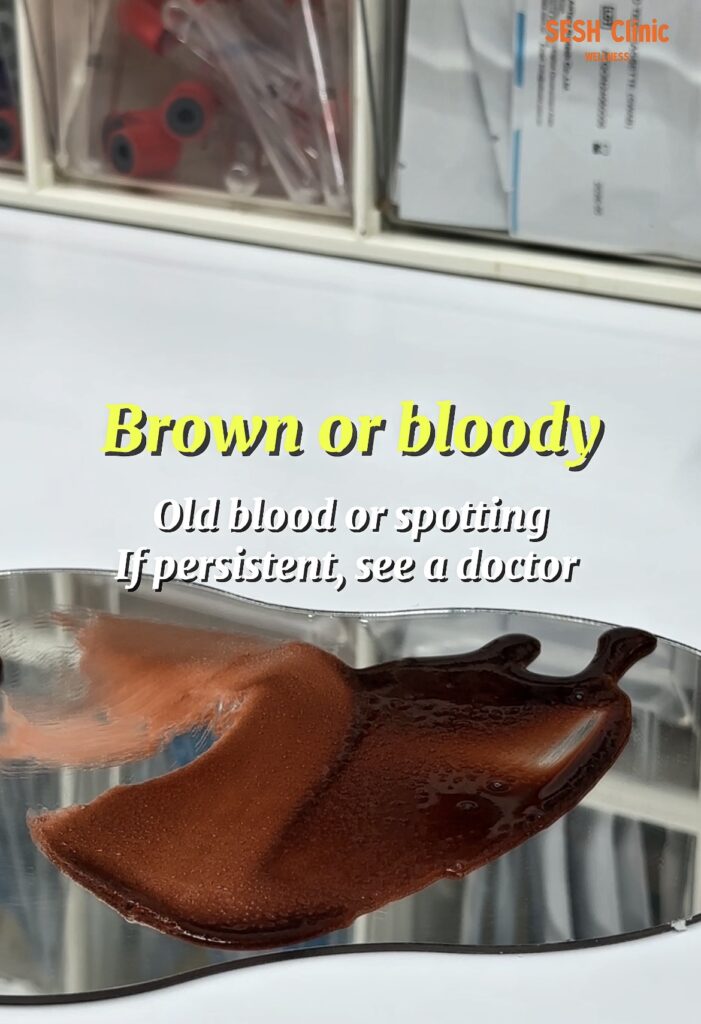
 It may also occur after:

  • Intense workouts
  • Stress
  • Recent sexual activity

 What to do: If spotting persists or occurs mid-cycle, consult your doctor to rule out hormonal imbalance or cervical conditions.

👉 Brown discharge after sex might also indicate mild cervical irritation.

Pink or Red Discharge — Fresh Blood or Irritation
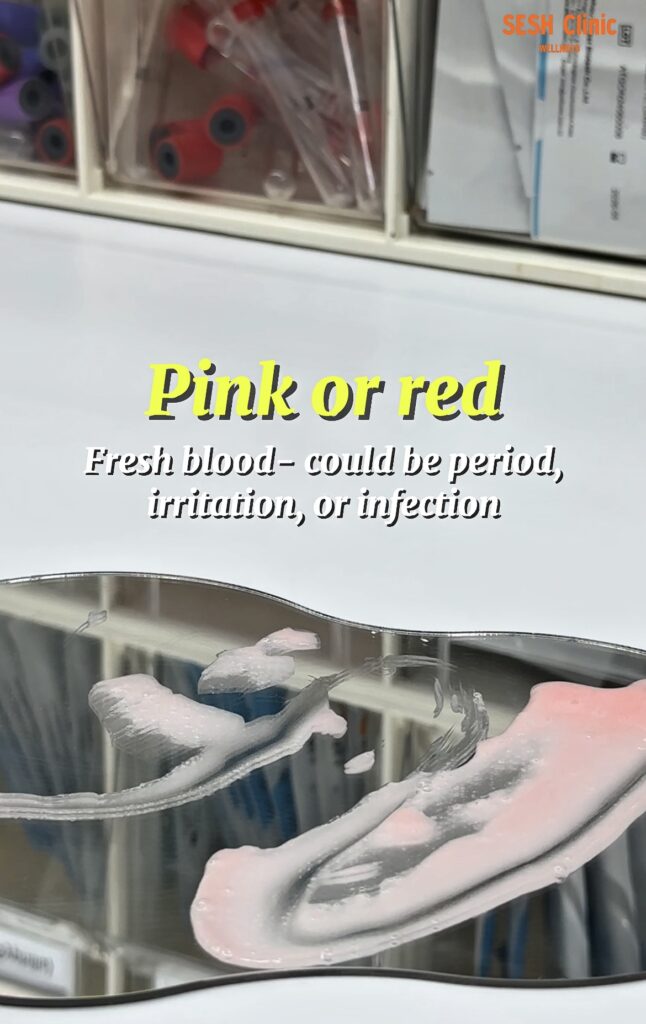
Pink discharge is often linked to:

  • The start or end of your period
  • Light bleeding after sex (cervical irritation)
  • Early pregnancy (implantation bleeding)

 Seek medical advice if:  Discharge occurs unexpectedly or has a strong odor — could suggest infection or inflammation.

 For more details, visit the – Vaginal Discharge Guide.

Frothy & Green Discharge — Possible Trichomonas (STI)

A frothy, greenish, foul-smelling discharge often points to trichomoniasis, a sexually transmitted infection (STI).

Other symptoms may include:

  • Itching or irritation
  • Pain during urination or intercourse

⚠️ Needs treatment!  Trichomonas requires antibiotics prescribed by a clinician. Ensure your partner is also tested and treated.

Learn more at the CDC’s Trichomoniasis page.

Yellow/Green & Thick Discharge — Possible Bacterial or STI Indicator

Thick yellow or green discharge with a fishy or foul odor may signal:

  • Bacterial Vaginosis (BV)
  • Gonorrhea or Chlamydia

 ⚠️ These infections require immediate medical attention — untreated, they can affect fertility and reproductive health.

Watery & Light Yellow Discharge — Often Normal

Thin, watery discharge is often normal, especially during exercise, ovulation, or arousal. Slight yellow tint may appear from air exposure.

Normal: Odorless and light
 ⚠️ Check-up advised: If itching, odor, or discomfort develops.

When to See a Doctor If You’re Wondering “Is My Discharge Normal?”

See a healthcare provider if you notice:

  • Foul, fishy, or strong odor
  • Itching, burning, or irritation
  • Green, gray, or bloody discharge (not period-related)
  • Pelvic pain or fever
  • Symptoms persisting after OTC treatments

 Pro Tip: Keep a cycle and discharge journal — it helps your doctor identify patterns and hormonal shifts.

How to Keep Your Vaginal Health in Balance

Do’s

✅ Wear breathable cotton underwear.
✅ Stay hydrated to support natural lubrication.
✅ Eat probiotic-rich foods (like yogurt or kefir).
✅ Practice safe sex with protection.

Don’ts

🚫 Avoid scented soaps, sprays, or douches — they disrupt your natural pH.
🚫 Don’t ignore persistent itching or irritation.

📖 Check out our internal post: Understanding Your Menstrual Cycle

If you ever feel unsure whether your discharge is normal, talk to a women’s health professional.

Home » Sexual Health
lkjlkm

m,mkl

Categories
Sexual Health STI Testing

STI PCR Test: The Most Accurate STD Testing in Bangkok

What is PCR Testing?

Sexual health plays a vital role in your overall well-being. However, many people delay getting tested for sexually transmitted infections (STIs) because of worries about accuracy, privacy, or waiting times.

Thanks to modern science, PCR (Polymerase Chain Reaction) testing has become the gold standard for detecting infections. Unlike rapid tests or blood antibody tests, a PCR test detects the DNA or RNA of the infection itself, not your body’s response to it.

What Does the STI PCR Test Detect?

One of the main benefits of the STI PCR Test is its comprehensive detection panel, covering both common and lesser-known infections — many of which are asymptomatic.

The PCR Panel can test for:

  • Chlamydia trachomatis A-K– a common bacterial infection that often shows no symptoms.
  • Neisseria gonorrhoeae (Gonorrhea)– a bacterial STI that can cause painful urination and discharge.
  • Mycoplasma genitalium (MG)– increasingly recognized as a cause of urethritis and pelvic inflammatory disease.
  • Ureaplasma urealyticum (UU)– usually harmless but can sometimes cause urinary or reproductive issues.
  • Trichomonas vaginalis (TV)– a parasitic infection that often goes unnoticed but can discomfort, irritation, and increased risk of acquiring other STIs.
  • Gradnerall vaginalis (GV)– a bacterial infection commonly linked to bacterial vaginosis (BV). It may cause unusual vaginal discharge and odor, though many people remain asymptomatic.
  • Trichomonas pallidum (TP)- the bacteria that cause syphilis, a serious STI leading to genital sores, rashes, and systemic complications if untreated.
  • Haemophilus ducreyi (HD)- the bacteria responsible for chancroid, a rare but serious STI that causes painful genital ulcers and swollen lymph nodes.
  • Group B Streptococcus (GBS)- a type of bacteria that may live harmlessly in the body but can sometimes cause urinary or reproductive tract infections, particularly in women.
  • Candida albicans- a yeast infection that may lead to itching, burning, and abnormal discharge in the genital area.
  • Candida glabrata- another yeast species that is less common but often more resistant to treatment, causing similar symptoms of genital yeast infections.
  • Herpes simplex virus type 1 (HSV 1)– a viral infection often associated with cold sores but can also cause genital herpes through oral-genital contact.
  • Herpes simplex virus type 2 (HSV 2)– the more common cause of recurrent genital herpes, leading to painful sores, blisters, and increased HIV transmission risk if left untreated.
  • Chlamydia trachomatis L1/L2/L3– strains that cause lymphogranuloma venereum (LGV), leading to swollen lymph nodes and rectal inflammation.
  • Candida paraphilosis– a yeast species that may cause genital itching, irritation, and discharge, sometimes resistant to standard treatment.
  • Candida tropicalis– another non-albicans yeast causing genital discomfort, redness, and recurrent infections.

(Some panels may also screen for HPV depending on your needs.)

💡 Why this matters: Many STIs are “silent.” For example, up to 70% of women and 50% of men with chlamydia don’t show obvious symptoms, yet the infection can cause infertility if untreated. PCR testing gives you peace of mind by catching these infections early.

How Does the PCR Test Work?

Getting tested at SESH Clinic Silom Bangkok is fast, discreet, and hassle-free.

  1. Step-by-Step Process:
  2. Sample Collection: Depending on the infection, a swab is taken from the genital area, throat, or rectum—or a urine sample may suffice.
  3. DNA/RNA Amplification: The lab amplifies genetic material to identify even trace levels of pathogens.
  4. Result Analysis: Our specialists review the results, ensuring high accuracy.
  5. 🕒 Turnaround Time: Most patients receive same-day results — enabling immediate treatment if needed.

The process usually takes only a few minutes at the clinic, and most patients receive same-day results, allowing for immediate treatment if needed.

Key Benefits of the STI PCR Test

The STI PCR Test is widely regarded as the gold standard, and here’s why:

  1. High Accuracy
    Detects infections that may be missed by traditional methods.
  2. Early Detection
    Identifies STIs even before symptoms appear, helping prevent long-term damage.
  3. Comprehensive Testing
    Covers multiple pathogens in a single test.
  4. Fast Results
    At SESH Clinic, results are often available within the same day.
  5. Privacy & Comfort
    Testing is completely confidential and handled by experienced sexual health specialists.

“Our PCR testing combines accuracy with discretion – giving you peace of mind and rapid answers.”
Dr. Praphatsorn Makmettakul, Sexual Health Specialist, SESH Clinic

At SESH Clinic, we we combine medical expertise with a confidential, judgment-free environment, so you can feel comfortable while protecting your health.

When Should You Get an STI PCR Test?

Regular testing is crucial because most STIs don’t show symptoms early on.

Consider a PCR Test If:

  • You experience burning during urination, discharge, or genital sores.
  • You’ve had a new or unprotected sexual encounter.
  • You’re in a non-monogamous relationship.
  • Your partner tested positive for an STI.
  • You’re scheduling a routine sexual health check.

Pro tip: Even if you feel healthy, getting tested every 6-12 months (or more frequently with multiple partners) is highly recommended.

Why Choose SESH Clinic for STD Testing in Bangkok?

There are many clinics in Bangkok offering STD testing, but SESH Clinic stands out for several reasons:

  • Privacy & Confidentiality: All tests are handled discreetly, with results delivered securely.
  • Experienced Specialists: Our doctors focus on sexual health and have years of expertise in diagnosing and treating STIs.
  • Advanced Laboratory Technology: We use PCR-based diagnostics for the highest accuracy.
  • Central Bangkok Location: Located in Silom, easily accessible for both locals and expats.
  • Same-Day Results & Treatment: No long waiting times—you’ll know your status quickly.

By choosing SESH, you’re not just getting tested-you’re investing in your long-term health and peace of mind.

Book Your STI PCR Test Today

Don’t wait until symptoms appear — take charge of your health today.

SESH Clinic provides fast, accurate, and confidential PCR STD testing in the heart of Bangkok.

👉 Book Your Appointment Now or call 064-567-1111 for same-day testing.

Frequently Asked Questions (FAQs)
1. How accurate is the STI PCR Test compared to other methods?

PCR testing detects the genetic material of pathogens, offering over 99% accuracy when performed correctly.

2. How soon after exposure can I get tested?

Most infections can be detected within 3–5 days using PCR technology.

2. Can I get results the same day?

Yes! At SESH Clinic Bangkok, most PCR tests provide same-day results.

3. Is the STI PCR Test painful?

Most people find the test quick and easy — it’s just a simple swab or urine sample. You might feel a little discomfort during the swab, but it only lasts a few seconds and is over before you know it. Our team always makes sure you’re comfortable every step of the way.

4. Do I need to prepare before the test?

There’s very little you’ll need to do to prepare. For a urine-based PCR test, please avoid urinating for at least one hour before your appointment — this helps us collect the best sample. For a swab test, you won’t need special preparation, though we may ask you to skip using creams, douches, or cleaning the area immediately before. Don’t worry — our team will walk you through everything and make you feel comfortable.

5. How often should I get tested?

If you’re sexually active with multiple partners, every 6–12 months is recommended. If you have symptoms, get tested right away.

6. Do I need an appointment?

Walk-ins are welcome, but booking ahead ensures faster service.You can registered anonymously!